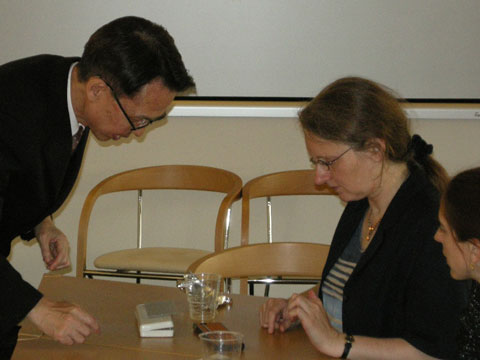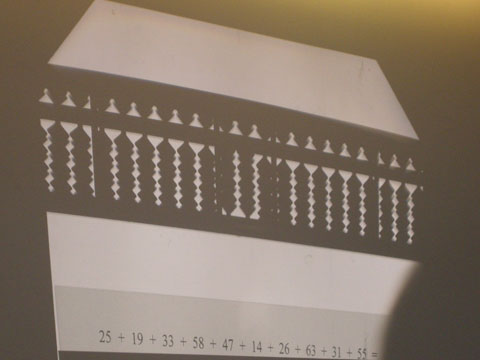
On Thursday 26 June, Club Nippon invited some of its members to try their hand at using an abacus (Soroban), the ancient method of calculation. The abacus dates back to around 3000 BC in the area of Mesopotamia, but was at that time a kind of table. Later, in China around the 2nd to 3rd centuries BC, the abacus consisted of a frame of wooden beads on metal rods, almost the same form and shape as it is today. today. It was introduced to Japan from China in the Muromachi period (1336-1573).
In Japan abacus classes has been compulsory since 1936, and today it is l taught in primary school. The abacus is still used in some shops in Japan, but it is becoming rarer. For a proficient user, it is faster than using a calculator, and proponents claim that there are many good reasons for using an abacus instead of a calculator. One of them is that you need to do calculations in your head while using an abacus and this activates and trains the brain. Using the abacus can help elderly people as it is good practice for staying metally healthy. The abacus trains one´s concentration, and by using the righ side of the brain, which some experts say is the centre of creativity, it can make one more creative.
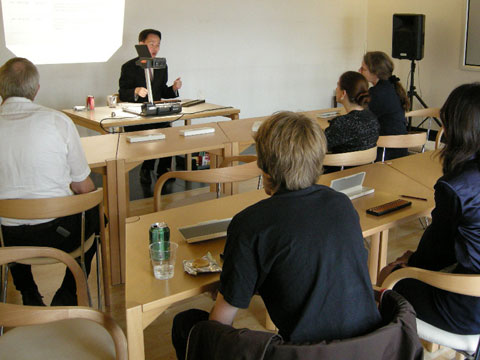
The instructor gave a brief, but interesting introduction to the history of the abacus and then explained how to use it. After which it was time for the audience to have a go themselves.
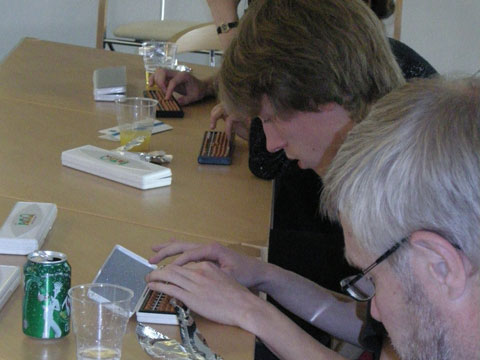
The instructor asked the audience to solve a few easy calculations which they did with variying degrees of success. Some got hold of the principle very quickly, while others agreed that being Danish was a disadvantage, since one was used to thinking about numbers in a different way because of the way they are expressed, for example 34 is referred to in English (and Japanese) as thirty four but in Danish "fireogtredive" (four and thirty). The instructor moved on to more advanced addition on the abacus which was rather difficult, but nevertheless great fun to try. It is possible to add, subtract and multiply on the abacus and thereby solve very complicated calculations.